
A postage stamp is a small, usually paper, item that can be affixed to a postal item such as a letter, postcard or parcel to show payment of postage or additional postal fees such as registration or express service.
The world’s first adhesive postage stamp was issued in England in May 1840 and depicted Queen Victoria. It became known as the Penny Black, and stamps soon began their worldwide spread. Its introduction is associated with Sir Rowland Hill, who sought to create a predictable, low and uniform postal rate affordable even to poorer people, with postage paid by the sender.
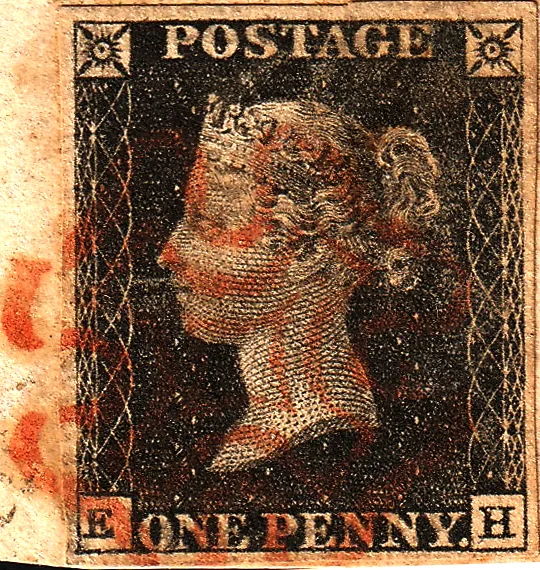
Beyond its primary postal function, a postage stamp can also tell us about the culture and ideology of the issuing country, its history, everyday life and much more. Every stamp has at least three stories. One concerns what or whom it depicts and why the stamp came to be issued. The second is the story of how the stamp itself was produced, from design to completion. The third concerns what happened to the stamp after production.
Essential characteristics of postage stamps:
- they can be attached to a postal item, for example by means of adhesive;
- they bear an indication of value;
- the issuing country can be identified from them;
- they are designed to be cancelled, usually by a postmark, to prevent reuse;
- forgery and fraudulent reuse are punishable by law;
- their issuer exercises full postal authority within its own territory;
- they are valid in international postal traffic and their issuer is a member of the Universal Postal Union (UPU).
The concept of a postage stamp is also defined by legislation as follows: “postage stamp: a stamp issued by the universal postal service provider, bearing an indication referring to its face value, which may be used to pay the postage charge on postal items and which contains the inscription “Magyarország” or its equivalent in a foreign language”. It should be noted that the word “stamp” has a completely different meaning in Hungarian criminal law; this will be discussed in connection with stamp forgery.
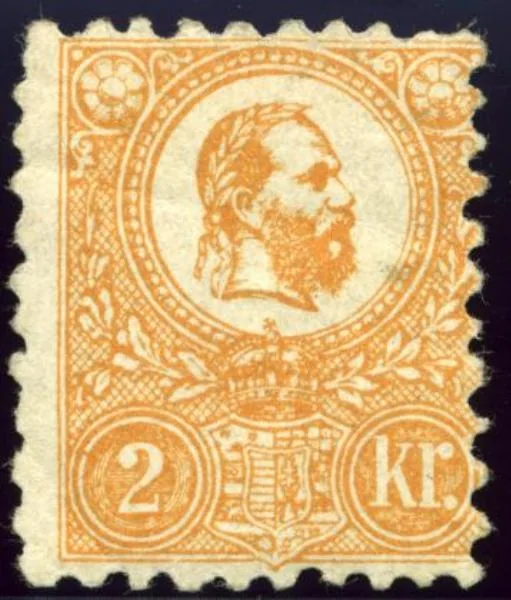
The first Hungarian postage stamps were issued in 1871, although the 1867 issue had already been produced to a Hungarian order, as an independent Hungarian postal administration was established following the Austro-Hungarian Compromise.
A sender may pay postage not only with adhesive postage stamps but also by purchasing postal stationery. Put simply, this may be a pre-produced envelope, postcard or illustrated card bearing an imprinted stamp or indicium, whose design has at times matched that of contemporary adhesive stamps. Postal stationery is also collected by philatelists, but it is not itself a postage stamp.
Postage stamps are generally examined according to the following philatelic characteristics:
- paper and watermark;
- printing process and ink;
- perforation;
- gum on the reverse;
- cancellation or postmark.
These characteristics allow us to identify stamps, assess their condition and recognise factors that increase or reduce their value.
Postage stamps are usually made of paper, but Hungary has also issued a stamp whose design was printed on aluminium foil. Stamps are generally rectangular, but other shapes are not unusual: triangular, circular and entirely unconventional forms also exist. Stamp production soon developed into an art form. Thanks to stamp collecting, it can also be an excellent source of revenue for postal administrations, because collectors buy stamps without necessarily using them for postage. In that sense, it is rather like buying bus tickets regularly but never taking the bus.
To meet collectors’ interests, stamp issues have become increasingly varied, with miniature sheets, souvenir sheets and stamps with attached labels or tabs. Advances in technology have given designers even more possibilities: Hungary has issued stamps with holographic foil, embroidered stamps and even paprika-scented stamps.
Occasionally, defective stamps also entered circulation. Such items became favourites among collectors, so a “factory reject” could become a treasure if only a few examples survived. Every such major error has its own story. This may also have inspired postal administrations to create intentionally scarce products for collectors. From the early 20th century, the Hungarian Post made imperforate versions available to collectors, later adding black prints, souvenir sheets with “green serial numbers” and other special products. Because these were produced in much smaller quantities, they can be considerably more valuable than ordinary issues.